Price Wars
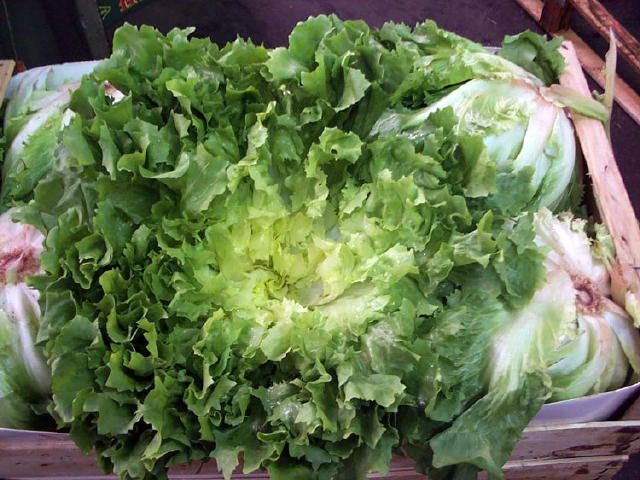
With the recipe for Escarole, Scarola, with Beans and “Bacon”.
The nonnas don’t go shopping. In their own language, they “make shopping,” and they “make shopping” a work of art. It is the con’s art of wearing down storekeepers to give them the best and freshest provisions for the least amount of money. These little women all in black, save for their printed-front aprons, look perfectly innocent. No con artist would leave the house in such an obvious get-up. As they trudge uphill, laden with heavy paper bags from each of the stores they’ve visited, they still have breath enough to tell one another the way they managed to score the day’s take.
It begins with the escarole. “I told Nick, the vegetable man, this escarole doesn’t look so good,” a nonna says. “I start taking off the outside leaves, one by one. I’m ready to put it back in the box, and he says to me, ‘It’s fifteen cents, but take it for a dime.’”
“Sure, ” says another nonna. “After what you did to that head, he knew he wouldn’t be abe to sell it to anybody else.”
“It’s tough to find things that are just right,” says another. “You got to be picky.”
””Pretend a little, too, like I did at the butcher’s,” the nonna says. (Remember, a nonna has no trouble squaring her conscience with her carryings-on.) “He has this chopped meat on a tray in the showcase. I want chopped meat, but I want to know what he’s chopping. I say to him ‘A pound of sirloin, please.’ When he takes out the steak, I say ‘Please chop that for me.’”
“You should have seen the look he gave you—as sharp as one of his knives.”
“In the bakery, you know the baker is going to grate the day-old bread into crumbs, and sell the crumbs, right?’ a nonna says. “So I ask him to sell me a loaf of day-old bread. I take it home and make my own bread crumbs. If I buy crumbs from him —fifteen cents. If I buy day-old bread—ten cents.” The bundles she carries prevent her from dusting her hands together to show that she has bested the baker; instead, she juts out her chin.
They approach the street where they live, and look in the window of the corner toy store. “New stuff,” one says. “The doll, she’s very nice for my granddaughter.” She enters the store.
The others follow. They pull bills out of change purses that were stuffed into their apron pockets. “For my grandson,” a nonna says, as she asks the storekeeper for a modeled-to-perfection miniature fire engine.
Another asks for the doll for her granddaughter and a rattle for her newborn grandson.
The transactions continue. As each pays, she comments on the fun the grandchild is sure to have with the toy. Bills are handed over. Change is received. And never is heard a haggling word. Why?
Because these are for the grandchildren —the only justification for ever paying full price.
Escarole, Scarola, with Beans and “Bacon”
Serves four
- 1 large head escarole, thoroughly washed, cored, sliced into thin strips
- 3 quarts boiling water
- 1 tablespoon olive oil
- 1/2 pound guanciale, or pancetta (Italian bacon), diced
- 2 cloves garlic, quartered
- 1 can, 12 ounces, best-quality canellini beans, thoroughly rinsed and drained
- Red pepper f lakes to taste
- Salt to taste
- Blanche escarole in boiling water 2 minutes.
- Drain, set aside.
- Over medium heat, in a large skillet warm olive oil
- Add diced guanciale; saute until golden and crisp; remove guanciale from pan; drain on paper towel.
- Add garlic, red pepper flakes, and sprinkle of salt to fat remaining in pan.
- Simmer garlic until golden; remove garlic; set aside.
- Add escarole, raise heat to medium high; cover pan.
- Steam escarole, covered, 5 to 7 minjutes, or until tender crisp.
- Reduce heat to medium, stir in beans; simmer 5 minutes, or until beans are heated through.
- Return sauteed guanciale and garlic quarters to pan; stir; serve.